

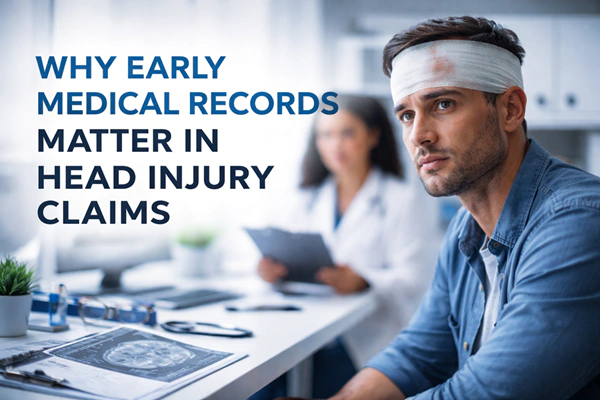
Head injuries can range from mild concussions to more serious trauma, and their effects are not always immediately obvious. In personal injury claims, early medical records often serve as the foundation for comprehending how a head injury occurred, how it developed, and how it continues to affect someone over time.
This blog explains why early medical records matter in head injury claims and what their role is for people in Winchester and the wider Hampshire area.
Why head injuries are treated differently
Head injuries are approached with particular care because symptoms can be delayed, subtle, or change over time. What feels like a minor knock at first can later develop into on-going headaches, dizziness, concentration problems, or fatigue.
Because of this uncertainty, medical professionals rely heavily on early assessments to establish a baseline. These records help distinguish between symptoms that appeared immediately after an incident and those that developed later.
In legal terms, this baseline is important for understanding progression rather than assuming severity from the outset.
What early medical records usually contain
Early medical records typically come from the first point of contact with healthcare services. This may be an A&E visit, an urgent care appointment, or a GP consultation in Winchester or nearby areas.
These records often note how the injury occurred, any loss of consciousness, immediate symptoms, and initial observations. They may also record what the injured person reported feeling at the time, which can be important later if symptoms evolve.
Even where scans or tests are normal, the fact that symptoms were recorded early can still be significant.
Why timing matters
The timing of medical records can influence how a head injury is later understood. Records created close to the time of the incident are generally considered more reliable because they are less affected by hindsight or memory changes.
Delaying medical attention can make it more difficult to pinpoint the onset of symptoms or their connection to the accident. A claim can still succeed, but early records reduce uncertainty.
For this reason, early documentation often provides clarity rather than conclusiveness.
Head injuries without visible signs
One of the challenges with head injuries is that they do not always involve visible trauma. There may be no cuts, bruising, or obvious external injury.
Medical records that capture reported symptoms such as confusion, nausea, sensitivity to light, or difficulty concentrating can therefore be particularly important. These symptoms may not be apparent to others but still have a real impact.
Early notes help show that these issues were present from the outset, even if they were not immediately disabling.
How medical records support understanding over time
Head injury claims often involve monitoring symptoms over weeks or months. Early records serve as a foundation for comparing later assessments.
This helps medical professionals and solicitors understand whether symptoms are improving, worsening, or fluctuating. It also assists in identifying whether new symptoms are linked to the original injury or have another cause.
In this way, early records support a clearer picture of the injury’s trajectory rather than a snapshot.
The Winchester healthcare context
In Winchester, early medical records may come from local GP practices, urgent treatment centres, or hospitals that serve Hampshire residents. As a claim progresses, one can access and review these records as part of a wider medical history.
Understanding how and where early records are created helps explain why consistency across healthcare providers can matter when assessing head injuries.
Why early records do not mean rushing decisions
Seeking medical attention early does not mean committing to a claim. Medical records exist to support health and recovery first.
Many individuals in Winchester attend medical appointments solely to verify and document their symptoms. Legal relevance often becomes clearer later, once recovery patterns are better understood.
Early records preserve information without forcing decisions.
Clarity through documentation
Head injuries can be complex, particularly when symptoms evolve gradually. Early medical records help create clarity by capturing what was known and experienced at the start.
For people dealing with a head injury after an accident, understanding the role of these records can reduce uncertainty and support informed choices later, regardless of whether a claim is ultimately pursued.